
National Playground Safety Week: How to Build Safer, Smarter Play Spaces
Every great playground starts with one thing: safety.
During National Playground Safety Week, communities across the country take time to evaluate and improve the spaces where kids play, grow, and explore.
But playground safety isn’t just about checking a box—it’s about thoughtful design, proper surfacing, routine maintenance, and creating environments where kids can take appropriate risks without unnecessary hazards.
Here’s what every park director, school administrator, church leader, and community planner should know.
What Are the Official Playground Safety Standards?
Playground safety in the United States is guided by industry standards and best practices from organizations like the National Recreation and Park Association, the Certified Playground Safety Inspector (CPSI) program, and the U.S. Consumer Product Safety Commission.
These standards focus on:
- Impact-absorbing surfacing
- Proper spacing and use zones
- Hazard identification (entrapment, protrusions, trip risks)
- Accessibility considerations
- Ongoing inspection and maintenance
1. Start with Smart Design
A safe playground begins long before installation.
Effective playgrounds are designed with:
- Age-appropriate play zones
- Clear sightlines for supervision
- Proper spacing between equipment
- Logical flow to reduce congestion
Good design doesn’t just improve play—it reduces risk.
2. Surfacing Matters More Than You Think
Falls are the leading cause of playground injuries, making surfacing the most critical safety feature.
According to industry standards, protective surfacing should:
- Be installed at a depth appropriate for the Critical Fall Height (CFH) of the equipment
- Cover the entire use zone surrounding each play component
- Be maintained to prevent displacement, compaction, and wear
Rather than relying on a fixed depth, effective safety depends on matching surfacing to the equipment and keeping it properly maintained over time.
3. Regular Inspections Are Non-Negotiable
Even the best playgrounds require ongoing maintenance.
Routine inspections should look for:
- Loose or damaged components
- Worn or displaced surfacing
- Trip hazards
- Rust or corrosion
Small issues can quickly become major safety concerns if left unchecked.
4. Supervision & Visibility
Playground safety doesn’t stop at equipment.
Safer environments:
- Allow for clear visibility across the play space
- Minimize blind spots
- Include seating or gathering areas for caregivers
When adults can easily supervise, risks decrease significantly.
5. Inclusive & Accessible Safety
Safety means making sure everyone can play.
Inclusive playgrounds include:
- Accessible routes and surfacing
- A variety of play experiences for different abilities
- Smooth transitions between play zones
Accessibility is a key part of creating a safe, welcoming environment.
6. Encourage Safe Risk-Taking
Not all risk is bad.
Developmentally appropriate challenges help children:
- Build strength and coordination
- Gain confidence
- Develop problem-solving skills
The goal isn’t to eliminate risk—it’s to design spaces where risk is appropriate and managed.
Why does it matter?
National Playground Safety Week is the perfect time to evaluate your existing playground—or start planning a safer, smarter space for your community.
Safe playgrounds don’t happen by accident. They’re designed, inspected, and maintained with purpose.
At Struthers Recreation, our CPSI-certified team helps communities create play environments that are not only fun—but built with safety at the core.
👉 Contact us to schedule a playground safety review or start your next project.

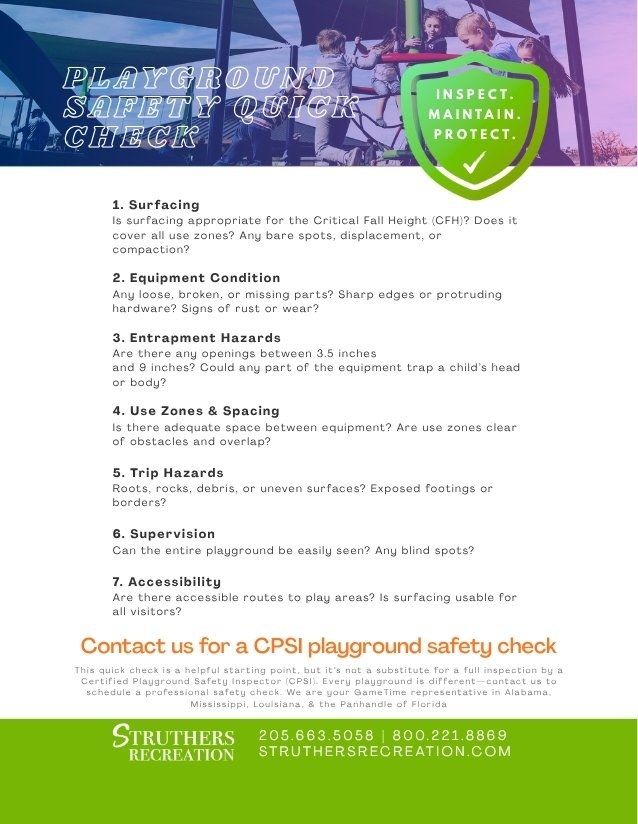
Playground Safety Quick Check
1. Surfacing
Is surfacing appropriate for the Critical Fall Height (CFH)? Does it cover all use zones? Any bare spots, displacement, or compaction?
2. Equipment Condition
Any loose, broken, or missing parts? Sharp edges or protruding hardware? Signs of rust or wear?
3. Entrapment Hazards
Are there any openings between 3.5 inches and 9 inches? Could any part of the equipment trap a child’s head or body?
4. Use Zones & Spacing
Is there adequate space between equipment? Are use zones clear of obstacles and overlap?
5. Trip Hazards
Roots, rocks, debris, or uneven surfaces? Exposed footings or borders?
6. Supervision
Can the entire playground be easily seen? Any blind spots?
7. Accessibility
Are there accessible routes to play areas? Is surfacing usable for all visitors?
>> Download your Playground Safety Quick Check
FAQ
Q: What is the most important factor in playground safety?
A: Protective surfacing is the most important factor, as most playground injuries result from falls.
Q: What is Critical Fall Height (CFH)?
A: CFH is the maximum height a child can fall from equipment and still be protected from serious injury by the surfacing below.
Q: Do playgrounds require 12 inches of mulch?
A: Not always. Surfacing depth should be appropriate for the Critical Fall Height of the equipment, rather than a fixed measurement.
Q: What are playground use zones?
A: Use zones are the areas around equipment that must remain clear and properly surfaced to protect children during play.
