
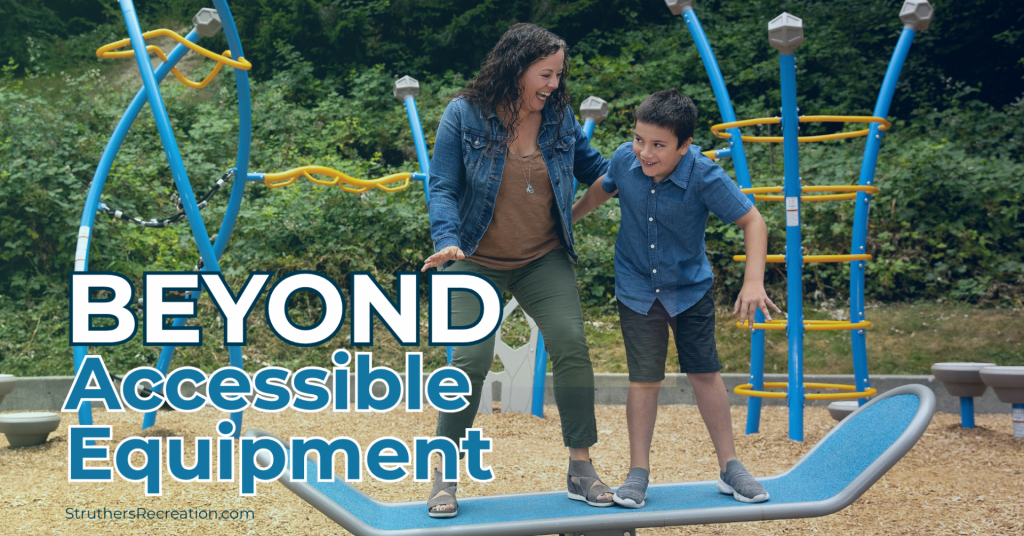
Beyond Accessible Equipment: How to Plan Parks Where Children, Caregivers and Older Adults Play Together
A playground can meet accessibility requirements and still leave caregivers, grandparents and older adults on the sidelines. Intergenerational park design goes further: it plans the entire park as a connected experience where people of different ages and abilities can arrive, move, play, rest and participate together.
That shift matters because inclusion isn’t limited to the equipment deck. It includes the route from the parking area, the location of restrooms, the comfort of seating, the visibility of play areas and the range of activities available across the site.
What intergenerational park design really means
Intergenerational design creates intentional opportunities for children, parents, caregivers, grandparents and older adults to share a park without forcing everyone into the same activity. A child might use a climbing feature while a grandparent walks a loop nearby. A caregiver might join a child at a sensory panel, then move to shaded seating with a clear view of the play area.
The goal isn’t to create one oversized playground for every age. It’s to connect age-appropriate choices through shared paths, gathering areas, landscape features and flexible spaces. Recent planning guidance from PlayCore recommends combining multi-age zones, sensory-rich options, accessible routes, seating, shade, wayfinding and activities with different levels of challenge.
Build beyond the equipment boundary
A strong plan begins with the whole site. Ask whether someone using a wheelchair, walker or stroller can reach the playground, restroom, drinking fountain, picnic area and open lawn without encountering a broken link in the route.
Use smooth, firm paths and create enough room for people to pass, pause and turn. Place seating near key destinations rather than at the edge of the action. Clear sightlines help caregivers supervise while staying engaged, and they give older adults a reason to remain part of the social life of the park.
Restrooms deserve early attention, too. New York City’s 2025 family-friendly public-space guidance identified restroom availability as a major gap in residents’ experience of public spaces. For park planners, that’s a reminder that practical amenities can shape whether families stay for 20 minutes or two hours.
Inclusive playground design for all ages
Inclusive playground design for all ages should offer more than one way to participate. Include ground-level activities, transfer opportunities, ramps where appropriate, tactile and musical elements, quiet retreat areas and spaces where children using mobility devices can play alongside peers.
Mix standard and accessible components within the same play environment instead of separating children by ability. Provide choices in height, movement, texture, sound and social intensity. Some visitors will seek active challenge; others may prefer imaginative play, gentle movement or observation before joining in.
This approach also benefits adults. A grandparent with limited mobility may not use every play feature, but they can still take part through companion seating, shared swings, interactive panels, walking routes or nearby fitness elements. Inclusive design works best when participation feels natural rather than like an exception.
Caregiver-friendly playground design
Caregiver-friendly playground design treats the adult experience as part of the play experience. Caregivers need comfortable, accessible places to sit, but they also need proximity, shade, clear views and enough space for personal belongings, strollers or mobility devices.
Arrange seating in several locations instead of creating one spectator zone. A bench beside a quiet activity supports one kind of visit; a shaded seat facing active play supports another. Picnic tables with wheelchair-accessible spaces, nearby water and convenient restrooms reduce the friction that can shorten a family outing.
Designers should also consider communication. Simple wayfinding, recognizable colors, readable signs and consistent routes can help visitors with cognitive, sensory or language-related needs navigate with more independence.
Age-friendly and child-friendly public spaces
Age-friendly and child-friendly public spaces share several qualities: comfortable walking routes, places to pause, access to nature, varied activity and opportunities for informal social connection. These elements can support a child’s curiosity and an older adult’s desire for movement, conversation or quiet observation at the same time.
Consider a looped walking path around the play area, a flexible lawn for intergenerational events, garden spaces, outdoor musical elements and low-impact exercise stations. Keep activities visually connected, but give each one enough room to function without creating congestion.
Community input should include children, caregivers, disability advocates, older adults, maintenance staff and nearby residents. Ask each group what prevents them from using the current park and what would make them return. A short design workshop or on-site walk-through can reveal barriers that a plan review may miss.
Plan for use, maintenance and change
A park’s long-term success depends on more than the initial layout. Confirm who will inspect routes, maintain surfacing, manage shade structures, repair amenities and update programming. Select features that match the community’s goals, budget and maintenance capacity.
Before finalizing the plan, test the experience from arrival to departure. Can a caregiver move easily while holding a child’s hand? Can an older adult find a comfortable place to rest? Can children with different abilities play near one another? Can staff maintain the site without closing major areas for long periods?
The best answer won’t be a single piece of equipment. It will be a connected park where access, comfort, play, movement and social connection reinforce one another. By planning beyond accessible equipment, communities can create places where children, caregivers and older adults don’t just visit together—they genuinely participate together. Let's Talk
