
From Accessible to Truly Inclusive: Rethinking Play Spaces for All Ages and Abilities
A playground can meet accessibility requirements and still leave people out. Inclusive playground design for all ages and abilities asks a harder question: can children, caregivers, teens, grandparents, and people with different physical, sensory, cognitive, and communication needs meaningfully play together?
That shift matters because inclusion isn’t a ramp added at the edge of a traditional playground. It’s a design approach that considers the whole experience—from the route into the park to the way people enter, choose activities, rest, communicate, and connect.
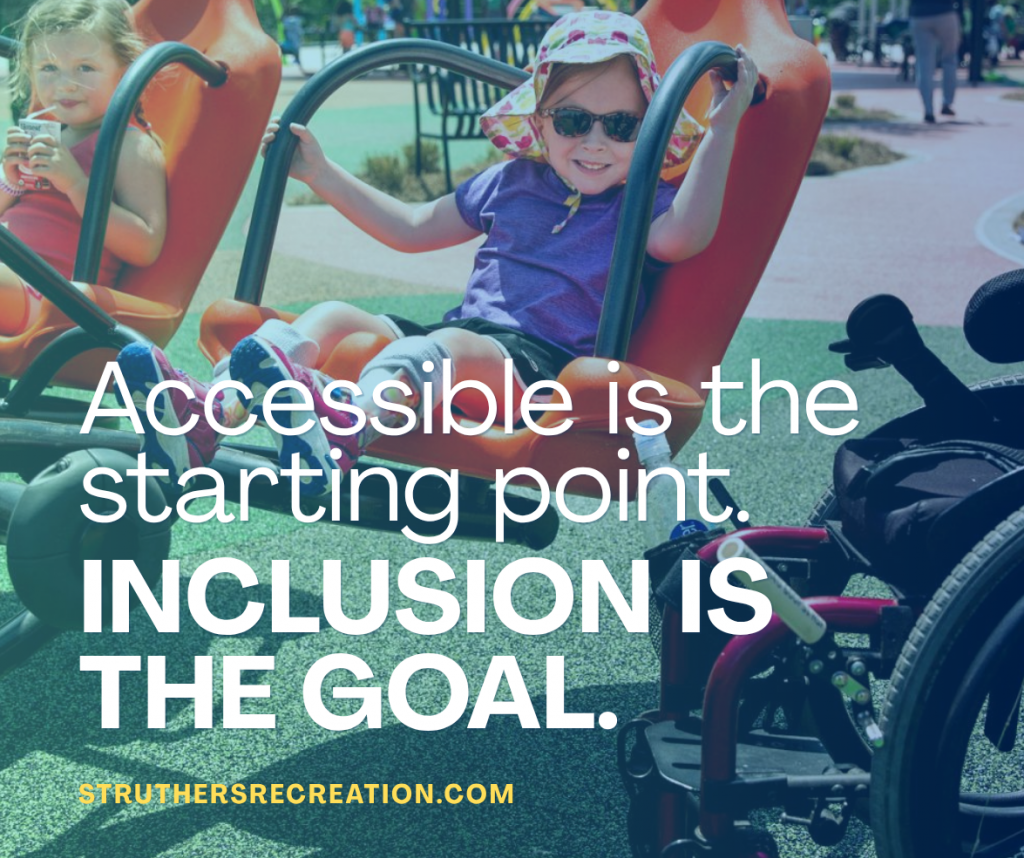
Accessibility is the starting point, not the finish line
Accessible design focuses on removing physical barriers and meeting applicable requirements. That work is essential, but it doesn’t automatically create belonging. A playground may have an accessible route while offering only one activity that a child using a mobility device can reach. A sensory panel may exist, but sit apart from the main play flow. A caregiver may be able to enter the space but have nowhere comfortable to sit within view of the action.
Inclusive design looks at those gaps. It asks whether people have comparable choices, whether play encourages interaction, and whether the space supports different ways to participate. The 7 Principles of Inclusive Playground Design can help planning teams evaluate the experience as a whole rather than checking features one at a time.
Reconsider the route, not just the equipment
The inclusive experience begins before anyone reaches the play structure. Review parking, sidewalks, curb transitions, gates, site grades, surfacing, and the connection between play areas and nearby amenities. If a route is difficult to navigate, the most thoughtfully designed equipment may remain out of reach.
Plan continuous, intuitive circulation through the space. Avoid making visitors choose between a direct route and an accessible route that feels secondary. Connect different activity zones so people can move from active play to social play, quiet areas, seating, restrooms, and shade without leaving the shared experience.
This is where accessible playground design for all abilities becomes more than a compliance exercise. The question isn’t simply whether someone can get to the playground. It’s whether they can move through it with dignity and make meaningful choices once they arrive. For a broader planning framework, review the 7 Principles of Inclusive Playground Design.
Design for choice and challenge
A truly inclusive playground should offer multiple ways to participate. Include activities that support movement, imagination, communication, social interaction, and sensory exploration. Provide a range of challenge levels so users can find an entry point that feels engaging without making every activity identical.
That might mean combining ramps, transfer options, ground-level activities, climbers, slides, rocking or spinning experiences, interactive panels, and open-ended spaces. It also means placing some activities close enough for children and adults to participate together—not dividing people into separate “accessible” and “standard” zones.
Choice also supports changing needs. A child may want vigorous movement during one visit and quieter exploration during the next. An older adult may join a grandchild in dramatic play rather than climb. A person with a temporary injury may need a different route or activity than usual.
Build multigenerational play into the plan
Multigenerational playground design treats the park as a shared community setting, not a children’s zone with caregivers stationed around the perimeter. Design for interaction between generations with comfortable seating, companion spaces, clear sightlines, walkable connections, and activities that invite adults and children to participate side by side.
Consider the full visit. Are there places to pause? Can caregivers stay close without blocking circulation? Do older adults have comfortable access to the play area? Are there nearby restrooms, drinking water, shade, and gathering areas? Recent parks planning guidance in Syracuse, New York, describes inclusive spaces as places where children, parents, and grandparents can share experiences and build connections across generations.
Planning teams can also use the 7 Principles of Inclusive Playground Design to keep social connection and shared participation in view as the site develops.
Make sensory inclusion part of the main experience
Sensory-inclusive playground design shouldn’t mean adding a token panel or placing all sensory features in an isolated corner. Think across the entire environment: sound, touch, sight, movement, texture, lighting, enclosure, and opportunities to observe before joining.
Offer both stimulating and calming experiences. Use varied textures and interactive elements, but also provide lower-intensity areas where visitors can pause. Avoid unnecessary visual clutter and consider how sound travels across the site. Clear transitions, predictable circulation, and spaces with different levels of activity can help people choose how they engage.
The goal isn’t to design one perfect sensory setting. It’s to provide enough variety that users can regulate, explore, and return to play in ways that work for them.
Ask the community before the concept is finished
The people who use a park can identify barriers that plans miss. Invite disabled children and adults, caregivers, educators, therapists, older adults, and local advocacy groups into the process early—not only after a concept is complete. Use walk-throughs, visual plan reviews, listening sessions, and post-opening feedback.
Then measure inclusion by experience. Ask who is participating, which areas remain unused, whether families stay longer, and what visitors would change. A compliant playground is a baseline. A successful one gives more people reasons to arrive, participate, connect, and come back.
Park planners who reconsider access, choice, circulation, sensory variety, and intergenerational connection can create spaces that serve the whole community. That’s the difference between adding accessible features and practicing inclusive playground design for all ages and abilities. Let's Talk
